Time :
2025-6-16 9:21:22Size:
[Large
Middle
Small
]Page View:
In the vast starry sky of manufacturing industry, laser processing technology is like a bright star, illuminating the road of high efficiency and precision in industrial production. Nowadays, a revolutionary technological innovation - laser processing robot three-dimensional surface calibration technology, with its contactless, high-precision, automated features, leading the industry's new changes. This is not only a technological leap, but also a powerful testimony to the rise of China's smart manufacturing in the field of high-end manufacturing equipment.
I. Revolutionary breakthrough of contactless calibration
In traditional laser processing, calibration has always been the bottleneck that restricts efficiency and precision. Manual posting of calibration points is not only time-consuming and laborious, but also prone to damage the surface of high-value workpieces, especially in aerospace, automotive manufacturing and other fields that require high precision and efficiency, this problem is particularly prominent. However, a new patented technology - laser processing robot three-dimensional surface workpiece calibration method and device, completely changed the situation.
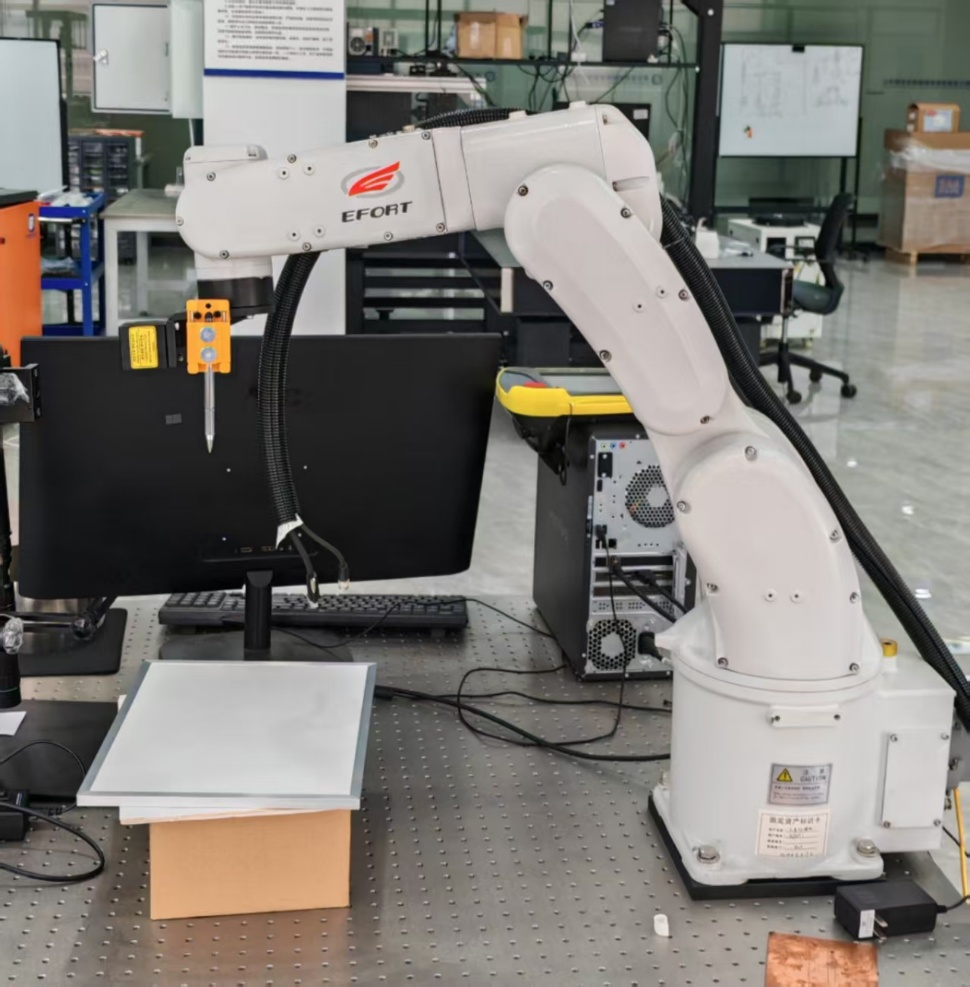
This core technology consists of three parts: multi-light source cooperative positioning system, intelligent geometry algorithm and visualized focal plane indicator module.
-Multi-light source cooperative positioning system: By setting at least 3 groups of non-collinear laser indicator light combination devices around the periphery of the laser processing head, each group contains 2 high-precision laser indicator units, and realizes ±0.01° level of angular fine-tuning through servo motors to ensure the high precision and stability of the calibration.
- Intelligent geometric algorithm: Based on the three-dimensional spatial coordinate mapping of the laser intersection point, it is able to solve the geometric features of the curved workpiece in real time, and generate the calibration point with sub-millimeter accuracy (accuracy up to 10μm).
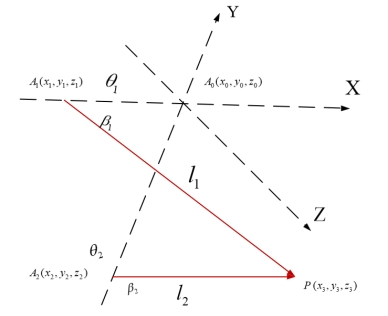
- Visual Focal Plane Indication Module: The laser focus/focal plane position is directly projected through the supporting device, allowing the operator to operate intuitively, realizing a “what you see is what you get” operating interface, which greatly improves the work efficiency and ease of operation.
Compared with the traditional manual labeling and calibration method, this technology realizes fully automatic contactless calibration, and the calibration time is shortened from 30 minutes/piece for manual labeling to less than 3 minutes/piece, and it can still operate stably under special environments such as high temperature, vacuum, etc., which completely solves the many pain points of the traditional calibration method.
II. the billion industrial automation blue ocean pioneers
In the aerospace, automotive manufacturing and precision mold industries, the low efficiency and high error of the traditional calibration method has been a problem that restricts industrial upgrading. This laser processing robot three-dimensional surface calibration technology for these industries has brought a new solution, greatly improving the industry's production efficiency and product quality.
From the market value point of view, this technology has a bright future. The global laser processing equipment market is growing at an annual rate of 12.3%, and the demand for high-precision surface processing in China accounts for 23% of the automation transformation budget in the manufacturing industry. It is expected that by 2025, the market size in the aerospace field will reach 1.26 billion yuan, the demand for new energy vehicle molds will reach 920 million yuan, and the potential market for 3C electronic micro-part processing is 830 million yuan. And this technology is expected to cover 30% of the head laser equipment manufacturers in 3 years, 8 years to occupy 55% of the market share of high-precision surface processing, its market potential is huge.
III., eight years of grinding a sword of technical attack course
The road to the development of this technology is not smooth sailing, but has experienced eight years of hard work. 2015, the team found that a space academy due to calibration errors led to the scrapping of the satellite bracket, the loss of up to 8 million yuan, which made them deeply aware of the shortcomings of the traditional calibration method, so as to establish the direction of the research and development. 2017, the first generation of prototypes was born, but faced with the problem of optical interference, the multi-laser beam crossover error up to 2mm. In the face of this problem, the team did not retreat, but continued to research, and finally broke through the “spatial decoupling algorithm of multiple light sources” in 2019, which improved the accuracy to 0.5mm, and won the support of the National Key Research and Development Program. 2021, the team cooperated with a German automobile manufacturer to test and achieve zero reworking in the calibration of the BMW 7-series carbon fiber roof mold. In 2023, we completed the third generation product iteration and passed the 1500℃ high-temperature environment verification, which laid a solid foundation for the application of the technology in a wider range of fields.
In terms of key technological breakthroughs, the response time of the servo motor closed-loop control algorithm has been optimized from 120ms to 18ms, the special calibration software RobotCalib 3.0 has been developed to support the dynamic compensation of six-axis robots, and it has been awarded the dual certification of UL/CE, which overcame the barriers to market access in Europe and the United States. Behind these achievements are the countless days and nights of hard work and unremitting efforts of the R&D team, their persistent pursuit of technological innovation and their insistence on perfect quality.
IV. Promoting intelligent transformation of the manufacturing industry
This laser processing robot three-dimensional surface calibration technology not only has great economic value, but also plays an important role in social benefits. As a gas pedal of industrial upgrading, it can reduce 3 skilled workers in a single production line, reduce labor cost by 40%, and help the construction of “black light factory”, a home appliance enterprise has realized 24-hour unmanned calibration operation, which greatly improves the production efficiency and competitiveness of the enterprise.
In terms of green manufacturing, this technology can reduce the use of reflective patch consumables by 120 tons per year (measured by 10,000 users), and reduce energy consumption by 35% (compared with the traditional optical calibration system), making a positive contribution to environmental protection and sustainable development. In terms of production safety, it avoids operators' exposure to high-temperature/radiation environments, which cumulatively reduces occupational cases by an estimated 2,300 cases/year, safeguarding workers' physical and mental health.
Source: Wenzhou Intellectual Property Protection Center