Time :
2025-5-30 8:49:30Size:
[Large
Middle
Small
]Page View:
At the beginning of 2024, engineers frowned in the R&D lab of Zhejiang Mock Laser Intelligent Equipment Co.
“Failed again!” The debugger sighed as he stared at the test data.
They were developing laser etching equipment for a new generation of chalcogenide solar cells. Lightweight and bendable, chalcogenide solar cells are an important direction for the future of the photovoltaic industry.
But the question arises - how to carve out the conductive lines on the curved surface that are thinner than a hairline?
Traditional galvanometer laser equipment on the plane with ease, but once faced with a curved structure on the etching P1/P2/P3 conductive line, like a “myopic eye can not hold the embroidery needle”, etching accuracy plummeted, resulting in the battery conversion efficiency is stuck in the 18%, the delay can not break through.
“We must find a new method!” Chen Gong, the project leader, stared at the experimental data with a firm gaze.
01
Four-dimensional linkage to overcome key challenges
Zhejiang MOC Laser Intelligent Equipment Co., Ltd. joined hands with Pentium Laser (Zhejiang) Co., Ltd., Wenzhou University, Zhejiang Pentium Precision Technology Co., Ltd. and other organizations to form a research and development team with talents in optical design, mechanical engineering, automation and other professional fields, to promote the project by adopting the agile development mode and overcome the technical problems.
The first hurdle: distance measurement problems
Laser triangulation, ultrasonic ranging, capacitive sensing ...... various programs tried all over, and ultimately found that the capacitive sensing accuracy is the highest, but after a few hours of continuous work, the temperature is high, the data will “float”.
“Can not let it ‘fever’!” The team worked day and night, designed “oscillation circuit + FPGA + MCU” three-level signal processing architecture, allowing the operating temperature range of -10 ℃ ~ 60 ℃, temperature drift coefficient of <0.01% / ℃, the measurement accuracy of ± 1 μm.
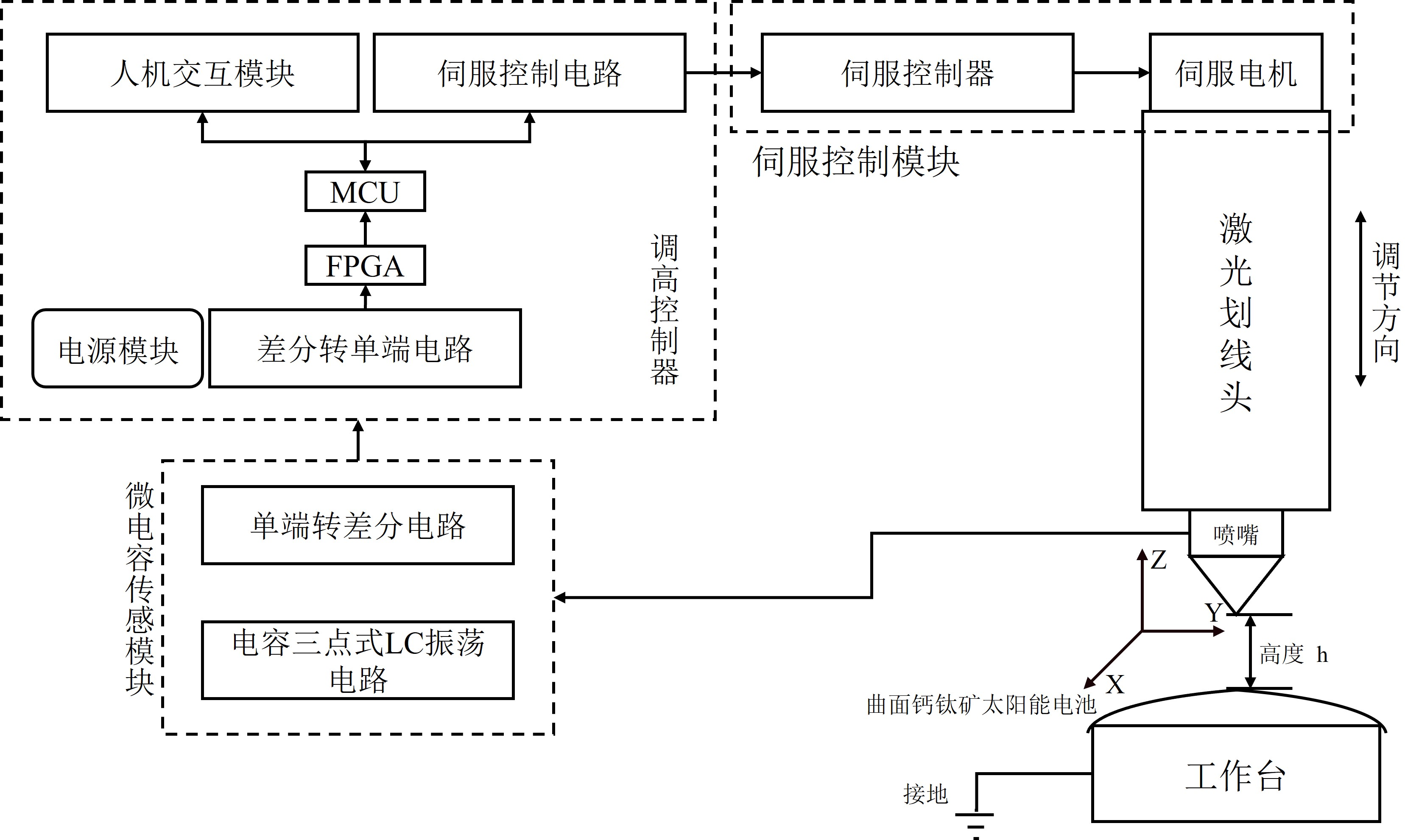
图1 “振荡电路+FPGA+MCU” 三级信号处理架构
Level 2: Dynamic Compensation
When etching curved surfaces, the laser head must adapt to undulations like “magnetic levitation”. The team developed a vision - ranging double closed-loop system, the use of CCD imaging real-time capture of surface features, with intelligent offset algorithms and dynamic warning mechanism, can identify 0.05mm deviation from the engraved line and automatically compensate for it, with a yield rate of up to 99.7%!
02
"The Birth of the Laser Embroidery Needle
“It worked!” Cheers erupted from the lab when the first curved cell was etched successfully. As verified by laboratory tests, curved substrates with a curvature radius of 50mm or more can be stably processed, which can cover the technical requirements of the current mainstream roof photovoltaics, building-integrated curtain walls and other application scenarios.
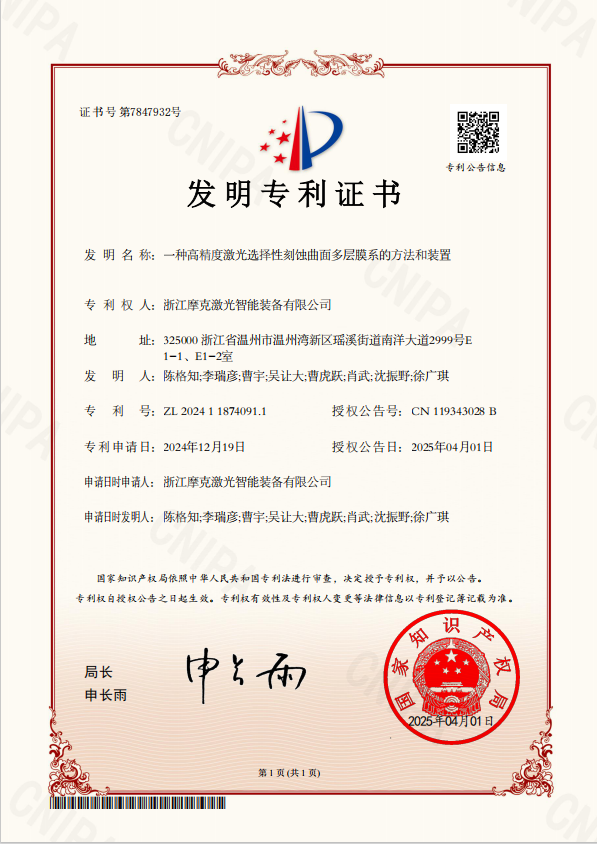
Fig. 2 Patent “A method and device for high-precision laser selective etching of curved multilayer film systems”.
At present, the R&D team is accelerating the equipment system integration and process validation work, it is expected that after the completion of the project will realize the calcium titanium ore battery etching accuracy of ± 3 microns, etching efficiency increased by more than 40%.
In the past, 80% of the domestic high-precision surface processing equipment relies on imports, expensive, high maintenance costs. According to preliminary calculations, the successful development of this new technology of the Moxa laser equipment manufacturing costs than similar imported equipment to reduce 25-30%, routine maintenance costs by about 40%. More critically, this technological breakthrough for the replacement of domestic equipment to provide a feasible program, so that China in the field of calcite photovoltaic equipment is no longer subject to others!
03
The future, it doesn't stop there
In 2025, the R&D team plans to complete 1,000 hours of continuous running tests and develop upgraded versions for larger radii of curvature.
“Our goal is to make Chinese photovoltaic equipment truly go global!” Chen Gong is full of confidence.
From “carve not allowed” to “embroidery level precision”, this technological breakthrough is not only the domestic equipment, but also another leap in China's smart manufacturing. In the future, when titania solar cells into the tens of thousands of households, perhaps we should remember - there is a group of engineers, had used the “laser embroidery needle”, carved a new chapter in the photovoltaic industry.
Source: Wenzhou Intellectual Property Protection Center